Blog

2009 Herald Hunt

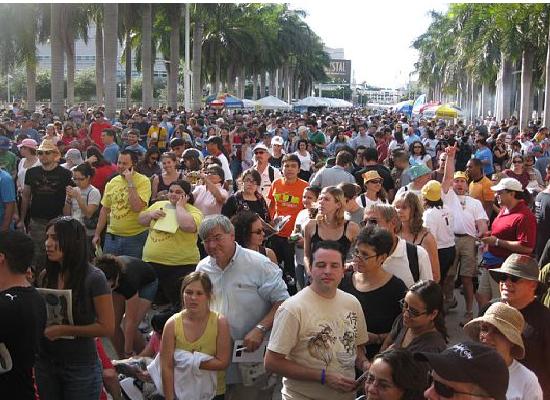
Great Herald Hunt yesterday. For once, the weather cooperated. No, it didn’t “cooperate” — it actively collaborated, and colluded. It was an unindicted co-conspirator. The kind of mid-70s low humidity day that makes people still want to live in South Florida despite the quality of driving there. And here’s  a fabulous Hunt quote in the paper today that perfectly captures the Hunt spirit:
“This might be it,” said Jeff’s brother, Rob, speaking of yellow dots on the pavement leading to the Venetian Causeway. “Absolutely not,” Jeff said. “I think that just might be for people working with the sewers . . . But we can’t rule anything out.”
herald hunt 2009

The full story, as usual, struggled to explain the Hunt, but it also included the puzzle-by-puzzle explanation.

After the last Herald Hunt, which took people an hour and a series of hints to solve, we intentionally made this one easier, and we succeeded. Huge percentages of the 5,000 participants seemed to have genuinely solved most of the puzzles, and the winner solved the endgame — the Final Solution (which requires solving all the preliminary puzzles first) two minutes after we issued the final clue.

Most people seemed to enjoy being able to get so deep into the Hunt and still be competitive, but a few complained it didn’t require “enough brain power” as one woman down from DC for the Hunt put it. I said, “So you won, then?” And she said, “Um, no.”

“Well,: I said. “Maybe if we had made it easier still, you might have.”

In the Details

boxsterAnyone who’s ever taken a writing course knows about the sacred totem of Significant Detail. Significant details are the small (or large) observations that say volumes about the subject of your piece. In the most powerful pieces, the significant details are SO significant, so perfect, they seem made up. You just can’t believe the writer got that lucky. And the best writers (who are also the best reporters) get lucky over and over again in spectacular, though non-sexual ways (sorry writer dudes, but being a great writer is no guarantee of female companionship, and I have abundant proof of that, though I refuse to name names).

So why do some writers get all the magical details? It’s either because they have an in with the Big Guy, or because the world is made simply loaded with magic braided into every crease and crevice of reality, and great writers have learned how to look for it and recognize it when they see it.

But really, it’s not that hard. The main trick is to KNOW that they’ll be there if you look for them. Then all you have to do is pay attention. Let’s imagine an example to illustrate how significant details pop up: A nice suburban family – mom, dad, two kids, two dogs — starts to fall apart. What details tell the story?

One day, the mom comes home with a new puppy, a cute, bouncy boxer. As you are admiring it, the dad comes out and makes a face: It was a surprise to him. He appears to laugh it off, but you wonder. A week later, dad comes home with a new Porsche Boxster. You happen to be there when he pulls into the driveway. Mom comes out, mouth open. This is the first she’s heard of it. She makes a joke of it, but really, how funny is a surprise purchase of a $50,000 car?

This family has always been yard-proud. The dad spends hours on his riding mower, keeping the large lawn well tended and fertilized. He’s planted a dozen small trees, including a peach tree which started bearing fruit a few years back, small but perfect and perfectly sweet peaches.

A few months after the boxer-Boxster incidents, some neighborhood teenager driving home after a beer bash late at night misses a bend in the road and plows straight into the peach sapling, totaling the car and sheering the tree off at bumper height. The gash in the lawn eventually heels, but the dead tree, about 6 feet of it with its tangle of branches, is simply tossed up under the shade of a spreading maple tree right in the center of the lawn. It would take about two minutes to drag the carcass across the lawn and toss it in the bordering woods, but that never happens. Ever. Season after season, the remains of the dead tree just sits there, a mess that just can’t be cleaned up or shoved under cover.

Six months later, you learn that the mom has moved out, marriage over, kids joint-custodied.

The spring comes again and the dad can still be seen out on his riding mower, the grass still perfectly manicured, the dead tree still rotting beneath the maple.

The point is, where there’s rot, there’s almost always a rotting peach tree. You just have to understand that, in one form or another, it will be there. All you have to do is keep your eyes open.

Dock’s No-No

This short animated film narrated by former MLB pitcher Dock Ellis about the day he pitched a no-hitter on LSD  is a wonderful example of how an extended quote from someone with a less-than-omniscient perspective can tell a story far beyond what the speaker himself understands. You’ll see that the animator got that, and was filling in around the edges in a goofy, but funny way.

Theatrical Hell

When you come across a brilliant detail in a work of  fiction, you might wonder, “Where do writers come up with this stuff.”

My guess: They had lunch with my friend Rachel, a brilliant young actress with a voracious appetite for ideas and ironies. Her artistic sensitivities are finely tuned, but she is also of that rare breed so deeply into drama that “experimental plays” and “alternative theater” are far more than punch lines to her. To those of us less attuned, her enthusiasms can appear, well, not to put too fine a point on it, fall-down-and-roll-around-on-the-floor funny. Here’s a description of a play she loved:
A one- man performance, by a mime, in which the mime appears to be struggling and failing to climb a mountain. FOR TWO HOURS.

You couldn’t possibly invent a more vivid image of theatrical hell for the average human than that. It has every form of tedium known to mankind all rolled up into a hyper-dense boulder of get-me-outtahere.

Wouldn’t it be beyond perfect for a Woody Allen vehicle, where his lust for the beautiful young thing forces him to sit through two hours of mimed frustration?

It would serve him right, of course, and that would be the point.

I Have Seen the Future of Journalism

… and it is surprisingly optimistic.

Just spoke at a high school journalism conference — 6,200 kids from around the country. There’s nothing like a Washington convention hotel filled to the rafters with bright, young, energetic, enthusiastic, having-the-time-of-their-lives 17 year olds. And this was a journalism conference?

I had to keep pinching myself. I’m thinking: what do they know that I don’t? What do they know that all the media pundits, corporate execs, Wall Street suits, and the moaning masses of working (and recently down-sized) journalists can no longer even imagine?

Based on the sheer tonnage of irrepressible perkiness I saw at the Wardman Marriott hotel this morning, I’d say that whatever problems journalism faces in the transition between a print world and a digital world will simply be swept away.

I told them about my first job in journalism, as a reporter at the Independent Florida Alligator – the Univeristy of Florida student paper. I knew even before college I wanted to be a writer. But I noticed something: I wasn’t actually writing anything. The only time I ever did was when I had a class assignment, and even then I couldn’t bring myself to do it until just before the deadline.

I had this realization while sitting on the side of a mountain on the island of Ibiza in Spain. It was toward the end of my junior year abroad program, and I had my journal with me, which I had barely written in. I was trying to write then, but it just wouldn’t come. So I was sitting there, all alone in this beautiful spot watching the waves of the Mediterranean beating on the red cliffs that jutted into the sea, and I thought: “What I need is a lot of deadlines.” Right then and there I decided that I would join the student newspaper.

When I got back to Gainesville, I found out where the office was and walked in unannounced. It was off an alley, a block off the main drag, in what used to be the kitchen of a greasy spoon restaurant. It appeared that nobody had even bothered to clean the place before the newspaper moved in, much less remodel. Directly above the news desk was an old stove hood, still thickly caked with black, toxic-looking grease. Beneath the hood was a guy with mustache and long brown hair who identified himself as the news editor.

“I’d like to write for the paper,” I said.

He asked if I had any experience.

“No,” I said.

“Doesn’t matter,” he said.

I asked him what did matter.

“Just show up,” he said.

And that’s been working for me ever since.

Like a Hawk

hawkHere’s the thing about cliches popping up in your writing: You’ve got to watch them like a hawk. But seriously folks, nobody’s immune. The first time anyone ever used that phrase to describe the need for intense attention, it was brilliant. Hawks can see a rodent in tall grass from 100 meters away. They not only have phenomenal eyesight, but they depend on it, and their attention to the smallest detail, for their survival. If a hawk isn’t paying attention, a hawk goes hungry. But after about the billionith use, “watch like a hawk”  just became lazy. No listener or reader would be instantly calling up the image of a survival-driven creature with superior eyesight peering into the brush because its life depended on it. “Like a hawk” just became a compound word that meant “carefully,” in other words, just the kind of bland, nothing abstraction that metaphors and similies are meant to bring to life. But it still means something. It’s a big blinking sign saying, “NEED A PRECISE OBSERVATION HERE.”

In the recent instance, the writer was describing the startup of a small business.  She’d just rented office space as market conditions went into decline. She was “watching every penny like a hawk.”

As a writer, as you read back that line, think of it as a cry for help. It tells you that you should replace the cliche with something intrinsic to the situation, something that makes that need for frugality more concrete. There are a million ways to do that, some better than others. But just consider a simple, direct solution, something like: “watching every penny like that would be the one that kept my office lights on.”  It transforms the line from a groaner, to something that does some honest work for the development of an idea.

The Final Rounds

Man, if this doesn’t show the magical tendency of a non-fiction narrative to resolve itself in spectacular, wilder-than-fiction ways: Consider the story of the decline of long-form journalism, then read this account of its final days in the newsroom of one of the former lead practitioners of the form. Pay particular attention to the closing paragraphs.

l

The Surreal Housewives

Hank Stuever was a brilliant chronicler of social culture — the deadend shopping strip mall, the man who cleaned up roadkill deer carcasses, the cult of the white plastic chair — but could he bring the same insouciant clarvoyance (in the strict sense of clear sight) to TV coverage. Well, bien sur. Check out his wonderful critique of the new Real Housewives of Orange County season. It practically shimmies and shakes off the computer screen: http://www.washingtonpost.com/wp-dyn/content/article/2009/10/29/AR2009102905242.html?sub=AR

You have to read it all. Every paragraph — every one – has it’s delights and revelations, it’s word play and sly subext. But here’s a favorite:

“This is Bravo doing what Bravo does best — imparting, in the slyest and most intuitive of ways, a sense of what’s right and what’s wrong. Much hubris (and many martini happy hours) brought us collectively to this point and now a new reality pervades the lifestyles that Bravo built its schedule exalting; the Great Recession has given its schedule more texture and human foible, and, in a way, it feels like the people at Bravo knew this would happen all along and set us on a path of social justice.”