Blog

Achenbach Strikes Back

Afraid of letting Hank Stuever run away with the day, Joel Achenbach dug deep and came up with a classic post on Achenblog, vintage Achenbach — smart, funny, self-referential to a self-deprecating degree, and actually making a good point that needs to be out there, ie: Tiger wasn’t really fooling anybody about being Mr. Family Man. As Joel notes:

The argument has been made a million times in the past two months that Tiger held himself up as a great guy and squeaky-clean family man, and earned all that endorsement money, and has now been exposed as a fraud and deserves whatever humiliation and agony he has endured. Weirdly, despite spending a fair amount of time staring at the TV, I somehow missed all the Tiger Woods Christmas Specials where we joined the Woods family as they sipped eggnog and discussed what’s going in the stockings. I barely knew the guy had kids. The one thing for sure is that he hasn’t faked beating the crap out of Phil Mickelson and everyone else for the last 13 years.

Just being clever can only get you so far. Real humor, like any other kind of writing, requires keen observation, and something interesting and novel to say.

Stuever Watch

spartacus

Hank Stuever is just now shifting into high gear in his new role as Washington Post TV critic. He totally kicked ass with his review of the new Spartacus. What other TV writer would think to begin as follows?

I am Spartacus’s trainer: We worked his core group for three hours a day, then did lower body strengthening for another two hours, then an hour of cardio, and then a Pontius Pilates cool-down. Every day. He ate nothing but egg whites and grilled chicken breasts. And now, just look at him.

I am Spartacus’s stylist: In the first episode of “Spartacus: Blood and Sand” (Friday night on Starz), he’s still a Thracian villager joining the Romans in war, and he’s a bit Visigothy, so we went with a wig of shoulder-length tresses with only the softest bit of curl. At first it was too “Spinal Tap,” and then it just came to me: Viggo in “Lord of the Rings”! Right? Later, in the second episode, thank God the story picks up the pace and Spartacus is captured and sent to that gladiator camp. Because then we come to that scene where they whack his hair off. But, hello? With a knife? Honey, we labored on that haircut. I didn’t want it to look too-too Caesar.

A Pontius Pilates cool-down? A bit Visigothy?

All his schtick is the perfect way to bring home the silliness inherent in these over-the-top costume dramas that really and truly are more about abs than Abyssinia. And nobody can be quite as convincing as Stuever is in loving something even as he cuts it to confetti, a la Edward Scissorhands.

The Communalist Revolution

macheteFor those who have a vested interest in decently compensated professional journalism, a sentimental fondness for it, or a core belief that what it contributes to democracy is essential, a recent OJR post by Robert Niles is important, if severely depressing, reading. I’d recommend  the whole piece, but the killer paragraph comes at the end, after he establishes that there is no real hope for replacing income lost to newsrooms forever:

“It’s time to … find a publishing and production model that allows a news publication to live within its current income means. That’s where the real change will happen in news publishing – the expensive, labor-intensive, manual newsroom model will give way to new, distributed, communal reporting and editing models, ones that are now being forged by journalist entrepreneurs. I wish that news businesses, foundations and journalism schools spending resources on searching for new funding models would abandon those futile efforts, and instead redirect that funding toward cultivating and studying innovation in news gathering and production. And in doing that, I wish that industry would quit looking to print editors and broadcast station managers for leadership and instead look toward online publishers and editors who are making nascent efforts work.

“Unfortunately, too many print and broadcast veterans don’t want to change their production model. So they instead devote their time and energy toward getting someone to fund another doomed quest to look for their revenue model Holy Grail.”

I think he’s nailed an inconvenient truth here. But he’s also glossing over what to me is the most troubling implication. By “distributed, communal reporting and editing models” he means some variation on “citizen journalists” and Wikipedia-type open source editing; newsrooms consisting of thousands of individuals with their laptops more or less volunteering their time, plus  whatever automated data dumps, gee-gaws and hoo-has can be innovated.

Anyone who has ever tried to produce high-quality, groundbreaking, earth-moving journalism — the kind that often requires individuals to ignore all other aspects of their lives, including family, physical health and sanity — understands just how unlikely it is that communal journalism will produce the same. It’s the equivalent of firing Shakespeare and hoping a million monkeys working together will produce Hamlet. Some journalism, and I would argue the most important kind, requires trained and experienced individuals to dig deep, break through every wall and wade through every swamp to get to the heart of  the matter — not to mention the talent and energy to make sense, and in some cases literature out of it.

Hard to volunteer for all that, without at least the solace of a decent pay day at the end of the slog.

But Niles’ point is that there’s no purpose served whining about it. And he’s dead right. An historic,even tectonic, shift is at work here. It used to be publishers had to own a printing press, a warehouse full of paper and a fleet of trucks. Now all you need is a $500 laptop. There’s no going back to the old economics that aggregated the wealth in a handful of large media companies, which in turn divvied up a portion of that to a group of carefully selected journalists.

Now those journos are increasingly on their own.

But I remain convinced that even as the new realities diminish the best kind of work the old order produced, the need and desire for that work will not diminish. At the same time, the tectonic shift that destroyed the old order makes it dramatically easier to build a new one.

To an ever increasing extent, an individual with the journalistic goods will become his/her own publisher, publicist and distributer. The cost of  finding and connecting with an audience based on interest, rather than geography, will approach zero. The economic scale will suddenly favor small operators, and make targeted, hightly motivated audiences available.

To adapt an Army rectuiting slogan, we can all become A Media Conglomerate of One.

The pathways to get there still have to be hacked out of the jungle, of course. But I recommend we all sharpen our machetes.

Mr. Natural

Can you guess what well-known personage made the following statement?

“I don’t like to hear cut and dried sermons. No—when I hear a man preach, I like to see him act as if he were fighting bees!”

The personality who said this would have been a natural writer. In a handful of words, he (ok, I’m giving you a hint, it was a man) not only manages to create an unforgettable, totally original  image that instantly conveys a complex activity — but he does so in a way that makes you burst out laughing. (The humor comes mainly because the two frames of reference, preaching and bee-keeping, are so discordant, yet when you think of the image, so perfectly apt.  The joke is that maybe they aren’t so dissimilar after all.)   It describes perfectly and lampoons brilliantly in the same phrase.

Now that I’ve written that last sentence, I realize I  could only be referring to one of two people: Mark Twain, and the man who actually uttered this remark.

One more hint:

Lincoln silhouette

Match Point II

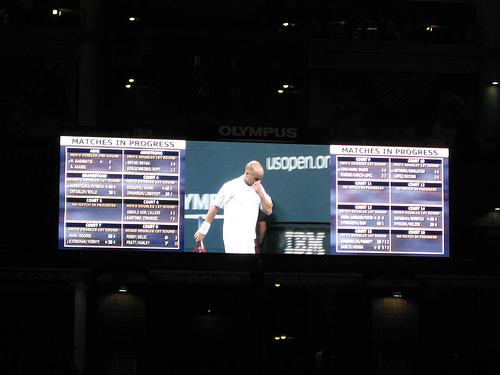
Agassi scoreboardSo I loved the book, admired the heck out of the craft. But there were two things I would have pushed if I were editing it. One of the central themes of the book, demonstrated beautifully, was that in spite of being one of the best in the world, Agassi HATED tennis. Really hated it. If I were Moehringer, I would have pushed him harder on that: Clearly he hated the pressure of expectations. He hated the toll it took on his body. He hated the loneliness and isolation, the endless repetition and the way it consumed his life. But did he hate the way it felt when his body executed a virtuoso maneuver, when he was able to leap from the court, swing perfectly, meet the ball at the sweetest possible spot and drive it over 100 miles per hour to the exact square inch of the court he’d chosen? When he was able to do that over and over again? Did he hate the challenge of the intricate chess match? The way tennis forces you to live in the moment, experience the primal fullness of battle without severed limbs and rotting corpses?
In addition, he discusses all the ways in which he rebelled, hoping that he’d get him tossed out of the Florida tennis academy which felt like a prison to him. But Moehringer needed to make him address why it was that he didn’t do the one thing he could have done to insure getting tossed out. Play badly, lose consistently, stop getting better. If he hated tennis so much, that would have seemed like the easy, obvious way out, yet he couldn’t do it.

Whenever you have an apparent contradiction in a set of facts, that’s exactly where you should concentrate your questioning, and where the answers will prove the most revealing.

The related issue is: Agassi never addresses what it was that made him, someone who hated what he was doing, stand out above all the other driven and pushed prodigies in the game. What was it that made him special, even among the tennis elite? He never even tries to address that, which would have been fascinating.

Match Point

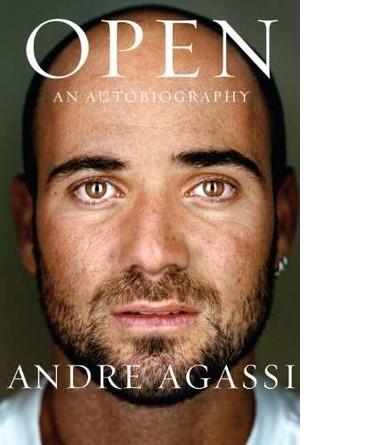
Open by Andre Agassi (and perhaps more relevantly for the purposes of this post, J.R. Moehringer) is a master class in how to engage readers by creating a story arc. Especially in biographies/autobiographies, there is a deadly tendency to inOpen by Agassiclude huge laundry lists of events and facts about a life just because, well, it’s a biography. Open includes plenty of facts that might have been groaningly boring, down to the minutiae of long ago and long forgotten sequences of strokes on an obscure  tennis court somewhere. But every single one of them is included only if it makes a point in the larger argument of the story.
It’s an axiom among tennis players that the surest sign of amateur play is hitting strokes with no purpose in mind beyond getting the ball over the net, or hitting it hard. Any expert player is trying to accomplish something very specific, something that itself fits into the frame of a larger game plan, with every swing of the racquet. The same is true of writing. The real pros are loath to waste a single word that doesn’t add to the larger meaning of the piece as a whole.

But how is it possible to tell a fairly complete tale of a life history in a random world without throwing in random facts? That’s where having vision comes in. Agassi wasn’t just writing a book because his famous career could command a seven-figure advance, he was writing it because he’d come to see his life as a desperate search for meaning, meaning that he ultimately found. His arc begins in a hell on earth, under the tonnage of his father’s thumb and the heat of his rage, then ascends through the central paradox of his life – that in order to save himself, he must learn to love the very instrument of his torture — to a hard won wisdom.

Agassi had a story to tell, and Moehringer was expert enough to help him tell it in the most riveting way.

Tiger Tracks

Perhaps the greatest verbal and narrative genius currently in operation is the PR team guiding Tiger’s damage control. The wording of his statements has been pure poetry. And the overall strategy is unerring. His statement today about taking “indefinite leave” from golf is the latest tour de force of PR thinking. His team realized the damage was so severe, they could never spin out of it. They had to create an entirely new narrative: The Resurrection and Return. So first, Tiger had to go away, disappear, die, in a sense. Only then could he reemerge after some “indefinite” amount of time (to be determined by his PR team taking the national temperature), at which point the story would be no more about Tiger the Hound, the Big Disappointment, but the New, Chastened, Rededicated and Refocused Tiger. The Comeback Kid.

Makes Strong Men Weep

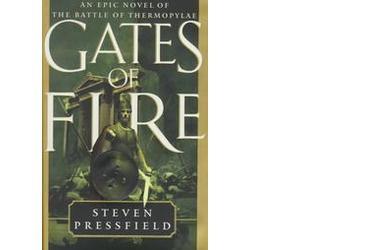
Gates of Fire coverI had this great encounter with Pete, the uber-personal trainer at the Y. He’s a guy you might take for a stereotypical jock.  He’s normally all about new ways to stress your core, but the other day he’d just read a book — a BOOK! — that had bowled him over, and he couldn’t stop talking about it. It was like someone newly (and gaggingly) in love who can’t stop going on about his beloved. And they say narrative is dead. Before we write the obit, we’ve got to account for Pete.
We did a small personality piece on Pete in The Washington Post Magazine, and in talking with him about that, it became apparent he didn’t read the magazine, or even the newspaper much. So his passion for the book, Gates of Fire by Steven Pressfield about the battle of Thermopylae, doubly surprised me.

“When I started getting near the end, I began to slow down because I didn’t want it to stop. And then when I read the last page, I almost began to cry,” he said.

Yes, the book, which is really about the culture of the Spartan warrior, does feature some rather extreme training methods (and by extreme I mean frequently  fatal). So clearly, that got Pete’s professional attention. But it’s not what made him want to cry when he ran out of pages.

Pressfield does a great job of immersing his readers in an alien world, featuring unspeakable brutality, yet full engagement in the real stuff of life (which always includes the proximity of  death). And he’s a master at building a narrative, creating characters you care about and constantly putting them in situations of high suspense.  He also deeply understands the technique of leaving key storylines hovering  in the background while he forges ahead with another high-action sequence. The unresolved issues, usually emotional ones, make the characters much more highly charged as they face the physical and tactical challenges of battle. The tension and excitement in the foreground effortlessly takes on a third dimension because of what you know about the emotional challenges pushed out of sight, but not forgotten.

Also, there is an oddly romantic appeal, especially to guys like Pete, of a life that is immediate, physical, close to the elements, purged of the falseness of modernity. A movie might also move Pete, but movies happen to you. You don’t feel like you are a participant, up inside the screen with all the characters. The power of written narrative is it brings the reader inside the pages, allows him to live there in his imagination. The “END” on the final page was a rude eviction notice, one worth crying over.

“I’m just waiting long enough to forget some of it,” Pete said, “then I’m going to read it again.”

I’ll Have What He’s Having

An add to my post on Stuever’s ability to turn the minutiae of  contemporary culture into fascinating repartee. One time Stuever and I had lunch in one of those $18-a-salad restaurants. We had some business to discuss, but I don’t remember what. What I remember is that we very quickly fell into what I always considered the real business of lunch with Hank: a far-ranging discussion of movies, books, celebrity cults, political pretensions, cubicle culture, whatever. About halfway through the entree, a woman dining at the next table leaned over and said: “I’ve never been so entertained by an overheard conversation. I need new friends.”

The Gift of Christmas Present

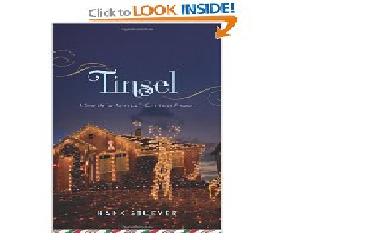
tinselHanging around with some families in the Texas exurbs for a few months before the holidays doesn’t seem like it would be all that riveting a subject for a book, but Hank Stuever has that unbelievably rare ability to peer deeply into the specific minutiae of contemporary culture and spin out insights that are both fascinating and hilarious.

Like when he’s talking about this city built out of the arid Texas plains, he points out that everything is either “back when there were nothing but cows” or brand spanking new. The highways, the houses, the malls.

“Sometimes even the people feel brand-new – in pretty gift wrap. Billboards on newly widened streets advertise Lasik so you can see new, cosmetic veneers so you can smile new; 1-800 numbers extol the miracle of reverse vasectomies, because new things are happening all the time. People smile at me with brilliant white teeth, and before long they are hugging me hello and goodbye, I learn how new and improved pairs of frankenboobs feel as they briefly press against my chest in understanding hugs of welcome.”

So magically, Hank takes a boring, non-descript town, and generic run-of-the-mill encounters with its inhabitants – nothing but straw – and spins it into the pure gold of social commentary. Not to mention makes it fall-down funny.

This isn’t a “trick” of writing. His words are brilliantly chosen, but it’s not vocabulary that makes the magic. It is brilliant observation and the perception of patterns. He sees in this purely artificial metropolis the underlying mania for newness. He understands that the thing that drives people to desire to live in such places is a desperation to break from the entanglements, the many mistakes and messes of the past – whether it be personal disasters or the general untidy nastiness of a world with too many flaws. The only salvation is to sterilize everything by boiling it in out-of-the-box newness.

Ok, now you know Stuever’s trick is more like clairvoyance than magic. He sees things we don’t notice, connects dots we miss entirely. He’s sitting high on a hill, watching the human comedy play out from a distance, and saying: “Wow, did you see that? Did you notice this?”

But even though he seems like he’s watching from afar, it’s actually by plunging in up close and personal with the very real people of his study that he generates his best material. Getting close enough, for example, so that he can have one of his subjects actually seek his advice about a parenting dilemma she faces. Now, watch what Stuever does when he isn’t working with straw, but 24-karat gold:

“If Emily asks me if Santa Claus is real, what do you think I should tell her?” Tammie asks me, one afternoon when we’re alone, in another house that is getting the garland-on-the-staircase, feathers-on-the-tree, full-on Tammie treatment.

I am ever a reporter, and, it’s important to underline here, not a parent. Virginia O’Hanlon was 8 when she asked her famous question, and that seems to me like a fine age to get just a bit more real. I had my own “No, Virginia” moment when I was 7, after Christmas Eve Mass with my family. As I was escorted, half-asleep, from the car to my bed, I overheard one of my big sisters — Ann, always the loudest — telling my mother that I was dead asleep and it was okay to start setting up Santa’s unwrapped gifts to me under the tree. I shed not one tear.

As a treasured piece of journalism history, the full text of “Yes, Virginia” fails upon further scrutiny, if only because its ultimate message is that there is something inherently wrong with skepticism. If a child has concluded, all on her own, that it’s impossible for a man in a flying sleigh to make it all the way around the world in one night, delivering elf-made replicas of all the stuff you see in Target and Best Buy, then that’s a child I would be happy to steer toward a voting booth when she’s 18. That’s an American in search of facts. If, however, she goes on pretending to believe well into her teens (I encountered more than one such teenager in Frisco), because it makes her parents (and God) feel sweet and happy, then I become worried. That becomes an American willing to spend $100,000 on her “special day” wedding, or who will believe without hard evidence that other countries harbor weapons of mass destruction. The angst over Santa’s existence comes not from the children, I think, so much as the grownups. The adults literally tear up when I ask them to talk about how, and when, their child will learn there is no Santa. Once you know there is no Santa, then there’s no stopping the awful truth about everything else.